 Dogecoin
 Payment Evidence Determines Whether to Wait, Retry, or Reconcile
Updated onDogecoin payments have zero confirmations until a miner includes them in a block. When that block joins the active chain, the payment has one confirmation, and each later block increases the count. A pending record calls for evidence before action: compare the transaction ID, outputs, fee, mempool visibility, input status, and wallet synchronization. If the transaction is valid and propagating, waiting is usually the cleanest choice. If it never reached peers or has fallen out of mempools, rebroadcasting the same signed transaction may restore propagation. If the transaction is conflicting or invalid, stop retrying and reconcile the payment record instead. Confirmation depth then determines when the recipient records the payment as accepted.
In short: A pending payment needs network evidence before any retry, while a confirmed payment needs a recorded acceptance threshold and reconciliation.
Evidence states and the matching response
Payment evidence falls into pending, confirmed, missing, and conflicting states. Each one points to a different response, even when a wallet groups several of them under a broad label such as pending.
A transaction that appears in mempools with zero confirmations is waiting for block inclusion. If its inputs remain unspent and its fee satisfies current relay and mining policies, more waiting may be appropriate. A transaction that exists only in the sender's wallet may need rebroadcasting after checking connectivity and validity. Positive confirmations support reconciliation against the recipient's chosen threshold. If another confirmed transaction has already spent the same inputs, the original payment cannot follow the normal path and should no longer remain recorded as merely delayed.
Acceptance rules before troubleshooting
An acceptance threshold is the recipient's operational rule, not a universal number imposed on every payment. A transaction has zero confirmations before block inclusion and gains one confirmation when its block joins the active chain. Each block added above it increases its depth. The payment amount, delivery risk, and ability to reverse an off-chain action can influence how much depth a recipient requires. Recording that threshold before investigating a delay prevents two different questions from becoming mixed together: whether the network confirmed the transaction and whether the recipient considers that depth sufficient.
What should you check before rebroadcasting?
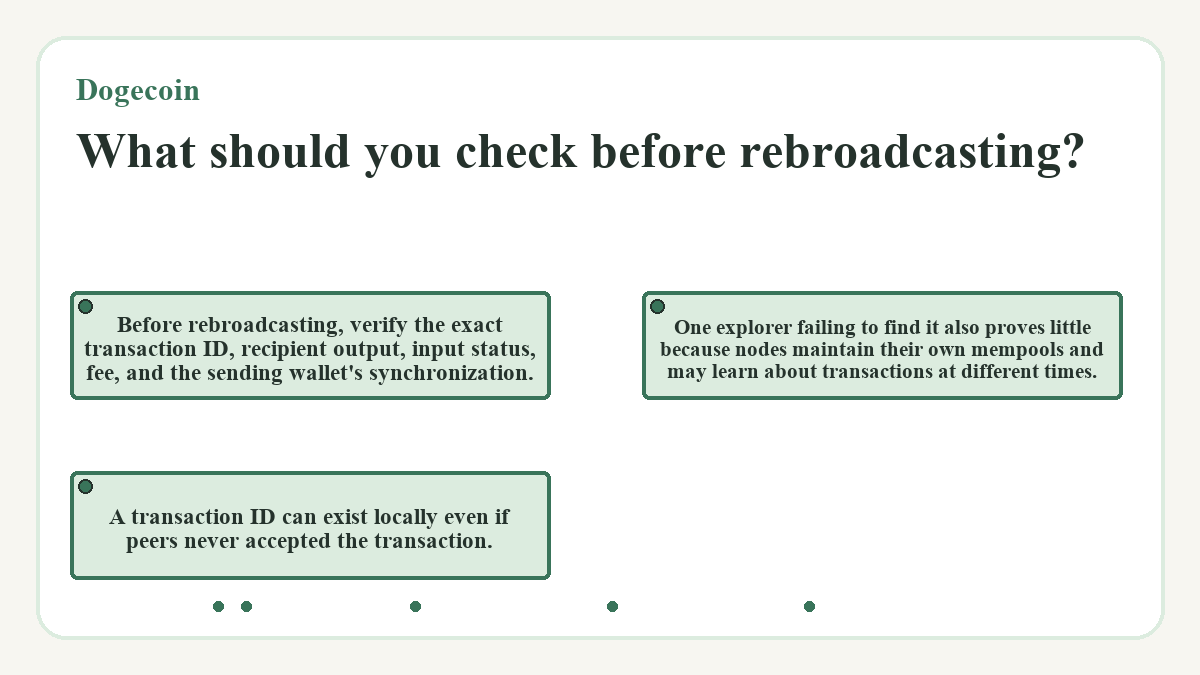
Before rebroadcasting, verify the exact transaction ID, recipient output, input status, fee, and the sending wallet's synchronization. A transaction ID can exist locally even if peers never accepted the transaction. One explorer failing to find it also proves little because nodes maintain their own mempools and may learn about transactions at different times.
Rebroadcast the original signed transaction only when its outputs remain correct and its inputs are still available. Identical serialized transaction data produces the same transaction ID, so another relay attempt does not create a second payment. It also does not raise the fee. If policy rejects the original fee, use only a replacement or rebuilding method that the wallet explicitly supports. Creating an unrelated second payment can leave the recipient with two valid transfers if the first one later propagates.
One transaction, different mempool views
A mempool is a node's temporary collection of valid, unconfirmed transactions, not a single network-wide waiting room. One node may hold a payment while another has not received it, rejected it under local policy, or removed it to manage memory. A transaction can therefore disappear from one public lookup without becoming canceled everywhere. Compare more than one synchronized view, then inspect whether the referenced inputs remain unspent. If peers still report the transaction but no block contains it, the observable state remains pending at zero confirmations.
A hypothetical payment from broadcast to settlement
This worked example uses three hypothetical inputs: a payment of 387 DOGE, a wallet-calculated fee, and an acceptance threshold of four confirmations. Assume the synchronized wallet selects unspent outputs, the sender checks the destination, and the wallet signs the intended transaction.
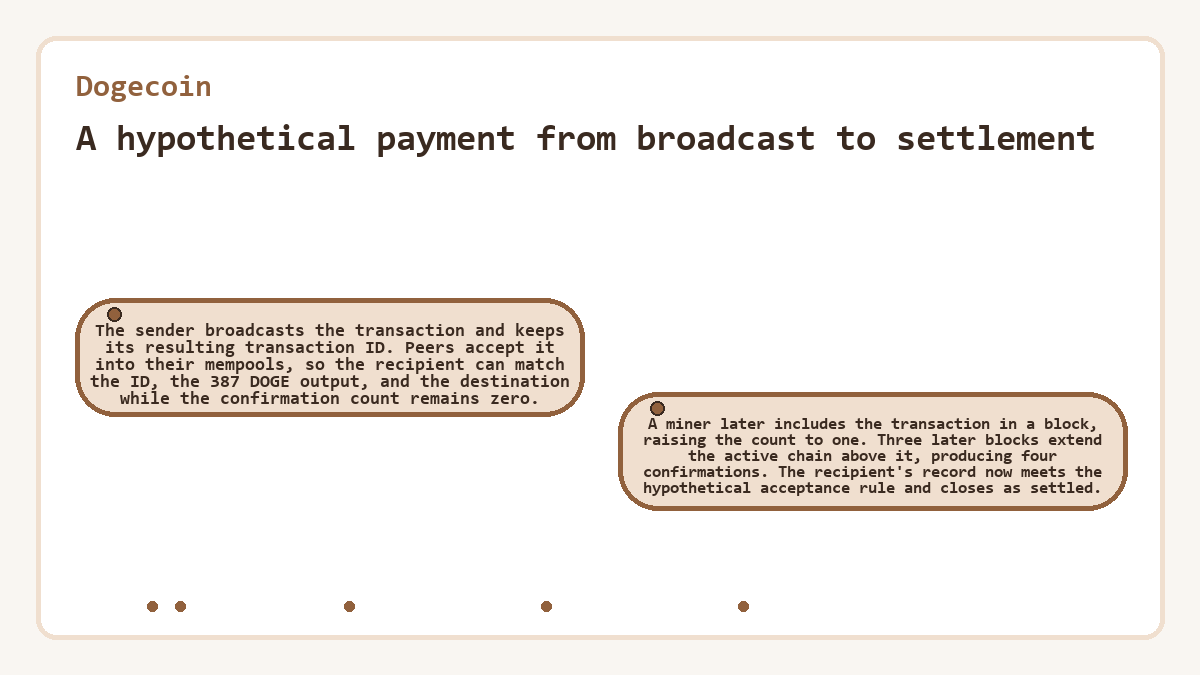
The sender broadcasts the transaction and keeps its resulting transaction ID. Peers accept it into their mempools, so the recipient can match the ID, the 387 DOGE output, and the destination while the confirmation count remains zero. A miner later includes the transaction in a block, raising the count to one. Three later blocks extend the active chain above it, producing four confirmations. The recipient's record now meets the hypothetical acceptance rule and closes as settled.
The wallet calculated the fee from the transaction's serialized size and its selected fee rate; the example does not promise a fixed cost or waiting time. If peers never accept the transaction, the sender checks the rejection cause before retrying. If a competing confirmed spend consumes an input, the sender stops retrying and reconciles the failed payment rather than treating it as slow.
Can a confirmation count go backward?
Yes. A chain reorganization can remove a transaction's block from the active chain, which lowers the displayed confirmation count or returns the transaction to an unconfirmed state. The transaction may enter a later block if it remains valid, or a conflicting transaction may prevent that outcome. A recipient should keep a payment open until it reaches the chosen depth and should update records if the active chain changes afterward.
Dogecoin's consensus parameters target one minute between blocks. Actual block discovery varies because proof-of-work mining is probabilistic, and miners choose transactions from the candidates available to them. Elapsed minutes therefore do not substitute for an observed confirmation count. Even a payment with an adequate fee has no guaranteed next-block deadline.
Wallet displays and network evidence
A wallet display reflects the blockchain and mempool data available to it, its synchronization point, and its acceptance settings. Its label alone does not settle a disagreement.
A wallet that has not reached the current chain tip may continue showing zero confirmations after miners have included the payment. The opposite mismatch can also occur when a sender's wallet remembers a locally created transaction that other nodes never accepted. Compare the wallet's latest processed block with a synchronized network view, then match the transaction ID and recipient output. An amount by itself is not a reliable identifier when several payments use the same value.
Transaction IDs and on-chain outputs are public data, but seed phrases and private keys are not verification material. No support request or payment check requires disclosing either secret.
Reconciliation after the network decision
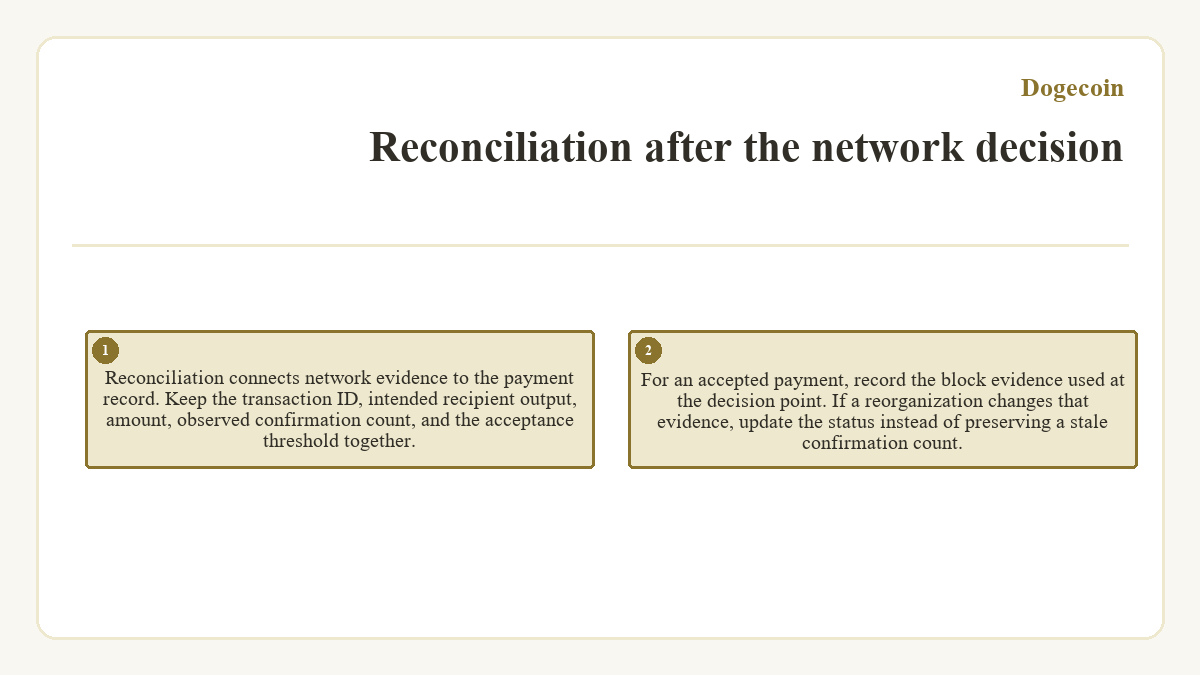
Reconciliation connects network evidence to the payment record. Keep the transaction ID, intended recipient output, amount, observed confirmation count, and the acceptance threshold together. For an accepted payment, record the block evidence used at the decision point. If a reorganization changes that evidence, update the status instead of preserving a stale confirmation count.
A failed or replaced attempt needs a different record. Preserve the relationship between the original payment request and any later transaction ID, but do not count both attempts as settled unless both transfers actually confirm. When the original transaction remains valid somewhere in the network, another payment using different inputs can create an overpayment rather than a repair. Closing the record only after the confirmed output and the intended obligation agree keeps a delayed payment distinct from a duplicated, conflicted, or abandoned one.
Frequently asked questions about Dogecoin
Does a transaction timestamp decide which Dogecoin payment confirms first?
No. A wallet timestamp records when software created or learned about a transaction, but it does not reserve a place in a block. Miners select from transactions they know about under their own policies. Block inclusion and the active chain determine confirmation order, so two payments created seconds apart may confirm in a different sequence.
Can an exchange credit DOGE later than the blockchain confirms it?
Yes. Blockchain confirmation and account credit are separate states. An exchange can require its own confirmation depth, deposit checks, or internal processing before updating a customer balance. The chain may therefore show a confirmed recipient output while the exchange still labels the deposit pending. Its required depth and credit status must be checked separately.
Can a pending incoming DOGE output fund another transaction?
Wallet policy determines whether it can spend an unconfirmed output. Any child transaction remains dependent on the parent: miners cannot confirm the child on the active chain unless the parent output also becomes valid there. If a conflict invalidates the parent, the child cannot confirm through that input, so neither the incoming output nor the child transaction should be treated as settled.
Does an abandoned Dogecoin Core status cancel the payment across the network?
No. In Dogecoin Core, abandonment is a local wallet action for a transaction that is neither in a block nor in that node's mempool. It can release the inputs for local use, but it does not delete copies held by other nodes. If other nodes still hold the original, the wallet cannot guarantee which conflicting transaction will confirm.